CFD analysis and experimental validation of different parachute geometries for unguided rockets
A predictive numerical methodology developed in collaboration with Be-Rocket to analyze and validate parachute aerodynamics and crosswind stability without relying solely on costly wind tunnel campaigns.
Explore Be Rocket ↗
THE CHALLENGE
Relying solely on physical wind tunnel testing for student-designed rocket parachutes is expensive, time-intensive, and limited when assessing crosswind behavior and static stability. To design optimized recovery systems for sounding rockets, there was a critical need for a reliable, predictive Computational Fluid Dynamics (CFD) methodology to evaluate different canopy geometries before manufacturing.
THE QUESTION
How accurately can steady-state 3D RANS CFD simulations predict the drag coefficients, flow fields, and crosswind static stability of various parachute geometries compared to experimental wind tunnel measurements?

HOW (METHODOLOGY & EXPERIMENTAL SETUP)
A multi-disciplinary approach combining CFD simulations, textile manufacturing, and custom wind tunnel test benches:
3D CFD Modeling (STAR-CCM+):
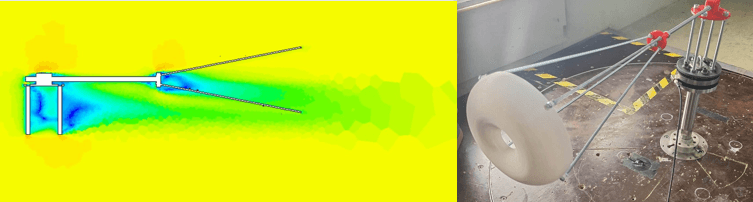
Set up numerical simulations using the k-omega SST turbulence model with polyhedral volume meshing and boundary prism layers across three distinct geometries (Elliptical, Toroidal, and Disk-Gap-Band / EGB). Verified numerical accuracy via domain independence and a Grid Convergence Index (GCI) study.

Flexible Canopy Testing:
Conducted tensile tests on nylon fabrics and seams, then laser-cut and stitched full-scale flexible parachutes to measure real-world baseline drag.
Custom Rigid Test Bench for Crosswind & Stability:
Designed, simulated, and built a custom test bench using interchangeable 3D-printed canopies on a 6-DOF load cell (ATI Omega 160).
This allowed measuring crosswind angles (0° to 15°) and static stability without fabric deformation, filtering out aerodynamic interference from the rig itself.

THE RESULTS
Validated Predictive Tool: The CFD simulation methodology proved to be a reliable predictive tool, matching the aerodynamic drag trends and crosswind behavior measured in the wind tunnel. This allows the team to virtually evaluate and optimize future parachute shapes without needing constant wind tunnel testing.
Rigid Test Bench Success: The custom 3D-printed setup provided clean, consistent data, proving that combining CFD with rigid scaled testing is an effective way to characterize stability moments.
Clear Canopy Selection for Rocket Recovery:
EGB Parachute: Showed the highest static stability and lowest lateral drift due to its geometric porosity -> Selected as the optimal drogue parachute.
Toroidal Parachute: Delivered the highest overall drag capacity -> Selected as the optimal main parachute for a soft landing.
Elliptical Parachute: Exhibited the lowest stability and highest drift under crosswinds.
PORTFOLIO
© 2026